
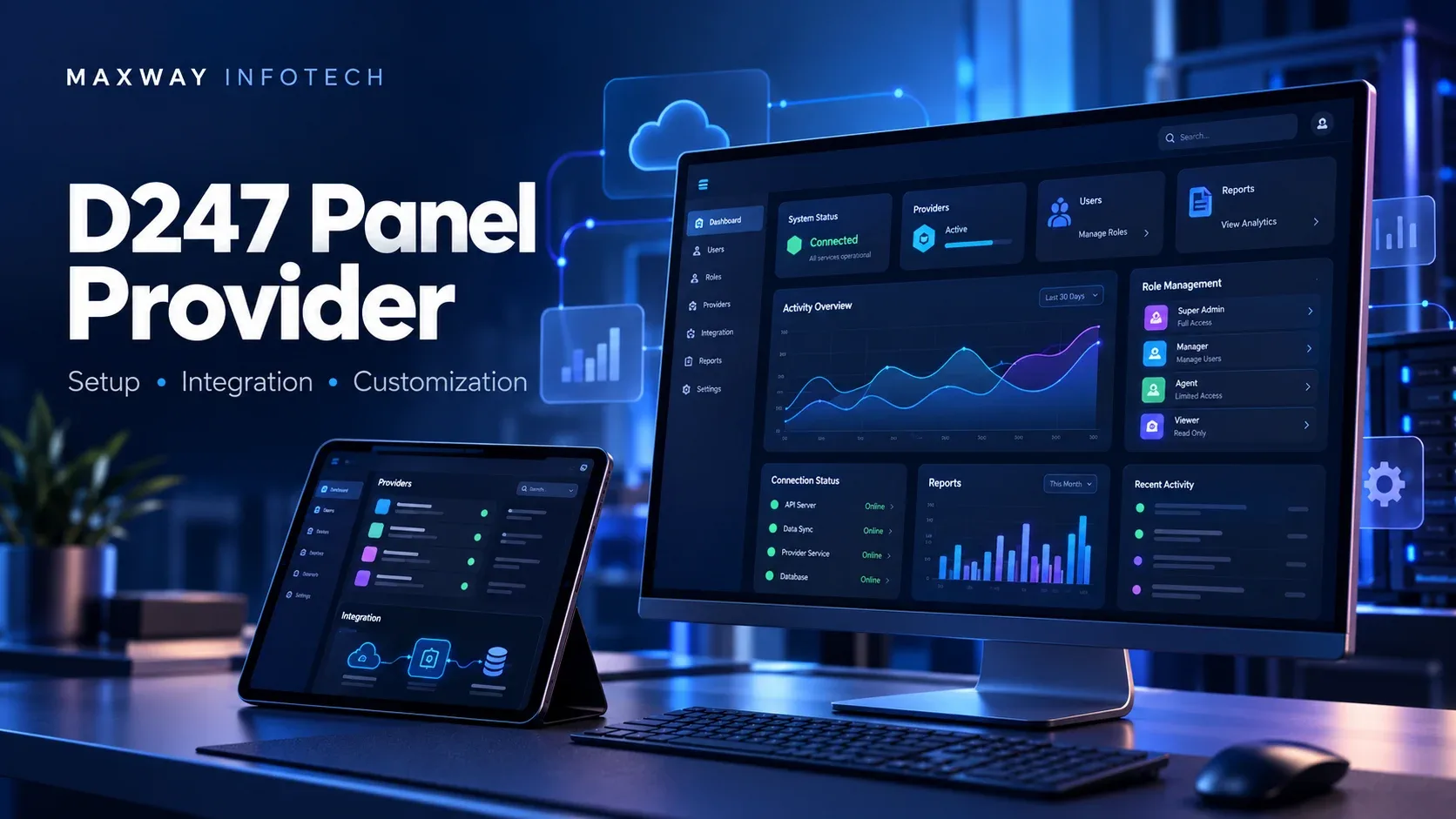
Looking for a D247 Panel Provider for a new project or an existing platform? Maxway Infotech provides custom panel development and API integration services. Discuss your D247 requirements with our team to assess compatibility, identify third-party dependencies and define the development work your business needs. Start with a clear scope, practical deliverables and an estimate based on your requirements. Panel configuration and customization planning. Website, backend and API connectivity assessment. Defined testing, deployment and handover requirements. Discuss Your Project | Request a Project Estimate A D247 panel provider may supply platform access, configuration, integration or related development services, depending on its agreement with the underlying vendor. Businesses should confirm which role the supplier performs. A project may include administrative interfaces, reporting and backend connections, while access rights and available functionality require separate verification. Before choosing a panel, identify what your team needs to manage more effectively. You may need clearer administrative controls, fewer manual reporting tasks or better connections between your existing website and external services. An attractive dashboard alone does not establish whether a solution fits your operations. The important questions concern what staff can do, which records they can access and how the system handles incomplete or incorrect information. For example, your finance team may need transaction references that match operational reports. An administrator may need permission to view activity without being able to change account settings. Write down these everyday tasks first. They provide a more useful starting point than a long list of features without clear business purposes. Maxway Infotech offers custom panel development and integration services for businesses building or improving gaming technology. For a D247-related enquiry, the first step is to establish what you already have: platform access, vendor documentation, an existing website or a proposed feature list. The team can then assess whether the requested work fits the available technology and permissions. Depending on that assessment, a proposed scope may cover: Existing-system and documentation review. Administrative interface development. Backend connections and data mapping. Branding and interface adjustments. Agreed testing and deployment work. Operating instructions and technical handover. API access, vendor subscriptions and third-party software are separate considerations. The proposal should identify who supplies each component and which dependencies must be resolved before implementation. A useful D247 panel setup begins with understanding your current infrastructure. A business starting from scratch has different requirements from one replacing a panel or adding functionality to an established platform. Share details of your website, backend, database and hosting environment. Explain how users and staff currently access the system, and identify any records that must remain available during a change. The review should answer practical questions: Can the existing backend accommodate the required connection? Does the project require a new interface? Which information needs to move between systems? Who controls production accounts and credentials? Is historical data migration required? These answers help define the work before development begins. They also make quotations easier to compare because each supplier is responding to the same requirements. A D247 admin panel should be evaluated against the responsibilities of the people using it. Owners, operational staff and reporting users may need different levels of access. Ask which permissions the selected platform supports. Where customization is possible, specify who can view records, make changes, approve actions and review activity logs. An application programming interface, or API, allows software systems to communicate through documented requests or messages. For D247 panel integration, confirm the available endpoints, authentication requirements, usage limits and supported functions. A panel name does not establish that every required feature is available through an API. If cricket connectivity is also part of your project, review our cricket betting api provider service to discuss those requirements separately. Decide what each report must show before commissioning it. A useful specification identifies the date range, filters, fields, export format and users permitted to access it. An activity report and a financial reconciliation report serve different purposes. Confirm their underlying data sources rather than assuming that one dashboard supplies everything. Where account balances or transactions are included, define how staff investigate pending, failed or disputed actions. Ask what references are retained, how status changes are recorded and which system holds the authoritative record. The implementation should follow the selected vendor’s documented behaviour. D247 panel customization may involve navigation, branding, report layouts or additional screens. The available changes depend on platform access, software architecture and contractual permissions. Separate editable elements from restricted vendor components. This helps avoid approving a design that the underlying product cannot accommodate. Have a feature list ready? Share it for a scope discussion. Consider this hypothetical example: a business already has a website and wants staff to review selected operational information through an administrative interface. The vendor provides documented access to the relevant information. The business backend receives it, maps the records to internal identifiers and presents permitted information to authorized staff. An administrator filters the records and investigates an incomplete entry using its reference number. If the external connection is unavailable, the interface shows the agreed status rather than presenting old information as current. This example illustrates one possible arrangement. It does not describe a verified D247 architecture. The actual workflow must follow the selected product’s documentation and the agreed project scope. For broader platform requirements, explore our sports betting API integration services. Explain your business workflow, existing platform, intended users and required changes. Identify the functions needed for the initial release and those that can follow later. Confirm the product identity, access arrangement, available functions and testing options. Missing documentation or permissions should be resolved before scheduling dependent development. Define the deliverables, responsibilities and exclusions. Acceptance criteria should describe observable results, such as a report displaying specified fields or a restricted user being unable to modify settings. Implementation may include backend connections, interface changes, configuration or custom modules. Review agreed milestones so business stakeholders can assess the work while changes are still manageable. Testing should cover the workflows in scope, permissions, unavailable services, incomplete responses and relevant performance requirements. Transaction-related work needs its own agreed checks. Document production configuration, access responsibilities and recovery arrangements. Handover should explain how the delivered components are operated and which issues require vendor involvement. Agree responsibility for software updates, connection changes and incident investigation. Additional features should be distinguished from maintenance so future work has a clear commercial basis. Businesses with an existing platform: You may need an integration review, clearer reporting or administrative interface changes. Bring the current architecture and a description of the operational problem. Businesses planning a new project: You may need help translating a feature list into a development scope. Confirm the proposed vendor and access arrangements before committing to implementation. Software teams coordinating several suppliers: You may need clear boundaries between panel software, data services and custom development. Assign ownership for each connection, account and acceptance decision. A project is not ready for implementation when essential access is unresolved or nobody can confirm which product is being integrated. Discovery can identify those gaps before a larger commitment. Maxway Infotech’s services span panel development, websites, applications and API integration. This combination is relevant when an administrative panel needs changes across several connected systems. Instead of discussing only the dashboard, you can bring the wider development requirement: the interface staff use, the backend supplying information and the external service involved. Review our company profile and development capabilities alongside your requirements. During consultation, ask for relevant project examples and an explanation of how the proposed work would be tested. The right fit should be established through clear answers, suitable evidence and a written proposal. D247 panel pricing depends on the selected product, access terms and development scope. A configuration project should not be compared directly with a custom platform build. Request an estimate that separates: Initial work: Discovery, configuration, integration, customization and testing. Vendor charges: Platform access, subscriptions and applicable usage fees. Infrastructure: Hosting, databases, backups and monitoring. Ongoing work: Maintenance, updates and separately scoped improvements. Delivery timing also depends on documentation, available access, existing-code condition and approval stages. Ask which assumptions could change the estimate. For related budgeting considerations, read our guide to cricket betting API cost and pricing factors. Its cost categories provide a useful comparison framework, rather than a D247 price list. Party Typical responsibility What to confirm Original platform or API vendor Controls its product, access and available functions Product identity, documentation, permissions and commercial terms Reseller or aggregator Distributes access or combines external services Distribution rights, upstream dependencies and escalation arrangements Development and integration company Builds agreed connections, interfaces or custom modules Compatibility, deliverables, testing and handover Client business Defines requirements and manages agreed operational responsibilities Account ownership, approvals, business rules and staff access One company may perform several roles. Ask each supplier to identify its responsibilities explicitly before comparing proposals. The inclusions depend on the selected product and written scope. A development project may cover configuration, backend integration, custom screens, reports and testing. Vendor access, hosting, maintenance and third-party charges should be identified separately so you can see the complete requirement. Potentially, subject to compatibility and access review. Share your website stack, backend details and vendor documentation. The assessment should establish whether the existing system can accommodate the connection or whether additional development is required first. You can request a demonstration and confirmation of what it covers. Availability depends on the selected product and access arrangement. Ask to see the workflows relevant to your project; a visual demonstration alone does not confirm production compatibility or usage rights. Sandbox availability must be confirmed with the selected vendor. A sandbox is a separate environment used for development and testing. Ask which functions it includes, what access is required and how its behaviour differs from the production system. Customization depends on technical access and the product agreement. Branding and screen changes may be possible where underlying transaction rules or proprietary components are restricted. Request a list of permitted changes before approving designs or budgeting for custom functionality. A reliable timeline requires a defined scope and technical review. Documentation quality, access readiness, existing software and testing requirements all affect delivery. Request a milestone-based estimate that identifies dependencies and the client decisions needed at each stage. Ownership depends on the development agreement. Custom code, vendor software and third-party libraries can have different rights. Confirm what will be delivered, what you can modify and whether any component requires a continuing licence or subscription. The proposal should name the responsible party for every account. Do not assume development fees include vendor subscriptions or permission to use a branded product. Confirm account ownership, permitted use and access continuity before implementation begins. Handover should cover the delivered components, configuration instructions, operating procedures and known limitations. Depending on scope, it may also include source code, test results and deployment documentation. Agree the handover checklist before development so completion is assessable. Maintenance is included only where the agreement states its scope and duration. Clarify coverage for defects, dependency updates, vendor changes and incident investigation. New features, migrations and major interface changes may require separate estimates. Choosing a D247 Panel Provider starts with a clear understanding of your project and the product you intend to use. Share your existing website or application, required features, vendor documentation, target market and preferred project scope. Mention whether you already have access or are still assessing suppliers. Maxway Infotech can discuss the development requirements and identify the next steps for a technical assessment.D247 Panel Provider: Plan Your Setup, Integration and Customization
What Does a D247 Panel Provider Do?
Start With the Business Problem You Need to Solve
Discuss Your D247 Panel Requirements With Maxway Infotech
D247 Panel Setup Around Your Existing Systems
Features to Discuss Before Choosing a Panel
Administrative Roles and Permissions
API and Backend Connectivity
Reports That Answer Operational Questions
Transaction Visibility and Exception Handling
Branding and Interface Changes
How a Panel Integration Could Work
From Initial Enquiry to Technical Handover
1. Review Your Requirements
2. Review Vendor Access and Documentation
3. Agree the Scope and Acceptance Criteria
4. Develop the Agreed Components
5. Test Routine and Failure Scenarios
6. Deploy and Hand Over
7. Plan Maintenance
Who Should Discuss This Service?
Why Consider Maxway Infotech?
D247 Panel Pricing: What Should Your Estimate Include?
Compare Responsibilities Before Choosing a D247 Panel Provider
Frequently Asked Questions
What is included in a D247 panel project?
Can a panel connect to my existing website?
Can I request a demo before proceeding?
Is a sandbox available for testing?
How much customization is possible?
How long does setup and integration take?
Will I own the source code?
Who arranges vendor accounts and access?
What should technical handover include?
Is maintenance included after deployment?
Discuss Your Panel Project With Maxway Infotech
In this article 35 sections
- What Does a D247 Panel Provider Do?
- Start With the Business Problem You Need to Solve
- Discuss Your D247 Panel Requirements With Maxway Infotech
- D247 Panel Setup Around Your Existing Systems
- Features to Discuss Before Choosing a Panel
- Administrative Roles and Permissions
- API and Backend Connectivity
- Reports That Answer Operational Questions
- Transaction Visibility and Exception Handling
- Branding and Interface Changes
- How a Panel Integration Could Work
- From Initial Enquiry to Technical Handover
- 1. Review Your Requirements
- 2. Review Vendor Access and Documentation
- 3. Agree the Scope and Acceptance Criteria
- 4. Develop the Agreed Components
- 5. Test Routine and Failure Scenarios
- 6. Deploy and Hand Over
- 7. Plan Maintenance
- Who Should Discuss This Service?
- Why Consider Maxway Infotech?
- D247 Panel Pricing: What Should Your Estimate Include?
- Compare Responsibilities Before Choosing a D247 Panel Provider
- Frequently Asked Questions
- What is included in a D247 panel project?
- Can a panel connect to my existing website?
- Can I request a demo before proceeding?
- Is a sandbox available for testing?
- How much customization is possible?
- How long does setup and integration take?
- Will I own the source code?
- Who arranges vendor accounts and access?
- What should technical handover include?
- Is maintenance included after deployment?
- Discuss Your Panel Project With Maxway Infotech