
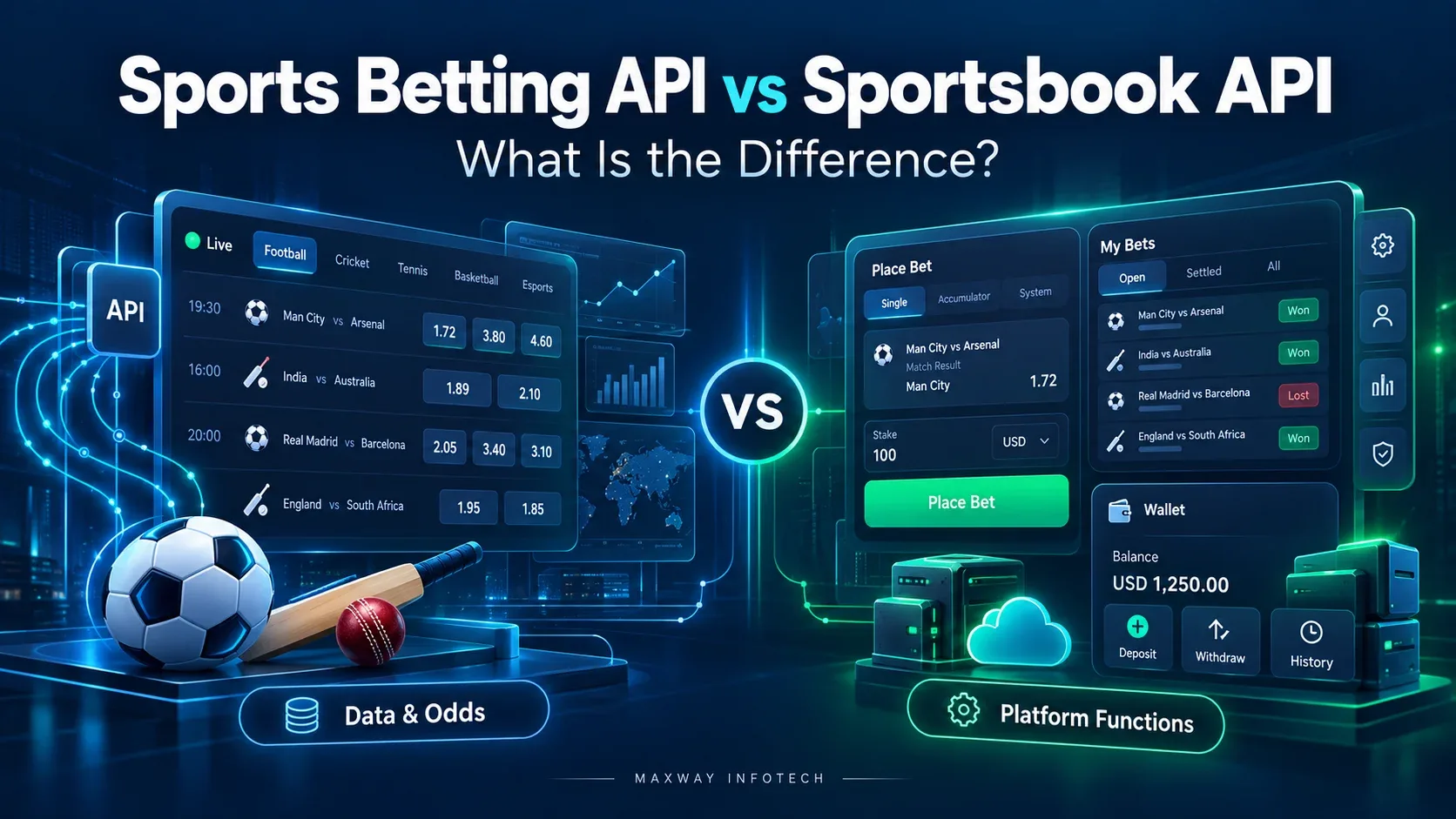
Sports Betting API vs Sportsbook API: What Is the Difference?
Comparing sports betting API vs sportsbook API can be confusing when providers use both names for similar products. For a business owner, the useful question is what the API actually does: supply betting data, process bets, or connect several parts of a betting platform.
This guide explains the differences, the overlap, and what to check before investing. Maxway Infotech offers integration and custom development services for businesses connecting these technologies to websites, apps, and backend systems.
Understand data feeds versus betting operations.
Compare features, dependencies, and integration work.
Prepare a clearer brief before requesting an estimate.
Already planning a project? Start by listing the functions your platform needs.
Quick Answer
A sports betting API is a broad term for an interface providing betting-related data or functions. A sportsbook API often connects software to sportsbook operations, such as bet placement and bet history. The terms overlap, so compare documented capabilities, access rights, and responsibilities rather than assuming the product name defines its scope.
What Is a Sports Betting API?
An API, or application programming interface, lets different software systems exchange information or request actions. In sports betting, that information might include fixtures, odds, markets, results, or event status.
Some APIs mainly supply data. Others expose transactional functions. This means “sports betting API” does not automatically describe a complete betting system.
For example, a sports comparison website might display prices from several bookmakers without accepting bets itself. Its main requirement is access to suitable odds data and permission to display it.
A sportsbook accepting customer wagers needs additional systems to validate bets, record decisions, manage balances, and handle settlement. An odds feed alone does not supply all those capabilities.
What Is a Sportsbook API?
A sportsbook API commonly connects an application with a sportsbook platform or betting engine. Depending on the product, it may support available markets, bet submission, acceptance responses, ticket history, and settlement records.
Account management, wallets, trading tools, and reporting may be included, exposed through separate interfaces, or supplied by another vendor.
Think of it as access to selected platform functions. It does not necessarily include the website design, payment processing, hosting, or every operational tool your business needs.
The documentation and contract should specify those boundaries before development begins.
Sports Betting API vs Sportsbook API: A Practical Comparison
The difference between sports betting API and sportsbook API usually concerns the product's scope. These are common patterns, rather than universal definitions.
Question | Data-focused sports betting API | Transaction-focused sportsbook API |
Main purpose | Supply sports and betting information | Connect applications to betting operations |
Typical functions | Fixtures, odds, markets, results | Bet submission, ticket status, bet history |
Can customers place bets? | Not unless transactional functions are provided separately | Potentially, where supported and enabled |
Wallet relationship | Often outside the feed's scope | May connect to an internal or external wallet |
Settlement | May deliver settlement instructions or results | May apply or expose ticket settlement status |
Typical project | Odds display, comparison tool, existing sportsbook feed | Custom betting frontend or sportsbook integration |
Main checks | Coverage, freshness, identifiers, usage rights | Acceptance rules, transaction safety, reconciliation |
An important exception: data feeds can include settlement and rollback messages. Sportradar's Unified Odds Feed documentation provides an example. Receiving those messages is different from maintaining a customer's balance or accepting their bet.
Start With Your Business Model
Before comparing vendors, decide what users should be able to do on your product.
You want to display or compare odds
A data-focused API may fit an editorial website, comparison product, or sports information app. Check bookmaker coverage, market identifiers, refresh behavior, and display rights.
Avoid paying for a transactional platform unless your planned functions require one.
You already operate a sportsbook
You may need a new feed, more sports coverage, or a better connection between existing systems. Review compatibility with your event catalogue, trading controls, settlement process, and reporting.
Replacing a feed can involve significant mapping work even when the website looks unchanged.
You want a custom sportsbook interface
A transactional API may connect a new website or app to an existing sportsbook backend. Confirm which system owns customer accounts, bet records, and balances.
This approach is unsuitable if the chosen vendor does not permit the required integration or cannot support your intended operating model.
Features That Matter More Than the Name
Coverage and market identification
Confirm the sports, leagues, and market types your business requires. Two providers may cover the same match while supporting different betting markets.
Consistent identifiers help your application connect the correct event, selection, price, and result. Team names alone are not a reliable matching method.
Live updates and market suspension
A live sports betting API should be assessed for how it delivers changes during an event. Depending on the vendor, updates may arrive through polling, streaming, or pushed messages.
Ask how your application detects stale data, suspended markets, and a disconnected feed. “Real-time” in a sales description is not a substitute for documented update behavior.
Authentication and access
Authentication verifies which system is making a request. Review credentials, access restrictions, supported permissions, and the process for replacing compromised keys.
Keep privileged credentials on the backend. A public website or mobile app should not expose secrets that grant unrestricted vendor access.
Bet acceptance and transaction records
A displayed price does not guarantee that a bet will be accepted at that price. The backend must handle the vendor's current acceptance rules and return a clear outcome.
If a request times out, check its status before resubmitting. Where supported, idempotency keys let repeated requests refer to one intended action, reducing duplicate processing.
Wallet and settlement handling
Confirm whether the platform uses a shared wallet, transfers between balances, or another model. Define how rejected bets, refunds, settlement changes, and reconciliation work.
Settlement corrections need an audit trail. Your team should be able to explain why a ticket status or balance changed.
How Integration Works: A Hypothetical Example
Imagine a business building a football betting interface on an existing licensed platform. This is an illustrative workflow; individual vendors use different designs.
The backend receives available events and markets, then sends suitable information to the website. When a user submits a selection, the backend requests acceptance from the sportsbook system.
That system applies its rules and returns an accepted, rejected, or pending result. The application records the response and shows the customer an appropriate status.
Later, settlement information updates the relevant ticket and financial records. If the connection fails midway, the integration checks the authoritative record before deciding what happened.
Good sports betting API integration therefore includes recovery and record consistency, alongside displaying odds and sending requests.
API Provider, Aggregator, or Integration Partner?
These roles carry different responsibilities.
An original provider operates the underlying API product or service. An aggregator brings together access to multiple sources, subject to its upstream agreements. An integration partner connects selected services to your software and develops the surrounding application.
One company may perform more than one role. Ask who supplies access, who invoices for it, and who handles upstream faults.
Maxway Infotech's Sports Betting API Provider page describes integration and custom development services. Treat API ownership, resale permissions, and vendor authorization as items to confirm for the specific proposal.
Do not assume a development contract includes third-party access rights.
How Maxway Infotech Fits Into a Project
Maxway's published service information describes API planning, frontend and backend development, testing, and deployment. These activities can help connect a chosen API with the rest of a business application.
For an odds-focused requirement, its sports odds API service information is a relevant starting point for discussion. For broader development background, review Maxway Infotech's company profile.
A project proposal should identify the actual deliverables: integration code, interface changes, data mapping, operational dashboards, documentation, or deployment support. Include only what the business needs and the selected vendor supports.
Ask for a walkthrough of a comparable workflow, including failure handling. This gives you more useful evidence than a general feature list.
A Sensible Implementation Process
Review requirements. Document your platform, target markets, sports, users, existing systems, and expected usage.
Review the vendor. Check documentation, access permissions, sample responses, rate limits, and test environments.
Agree the architecture. Decide which system owns accounts, wallets, tickets, and settlement records.
Build the integration. Connect the required functions and implement validation, logging, and recovery behavior.
Test realistic failures. Include price changes, suspended markets, timeouts, duplicate messages, and settlement corrections.
Deploy and hand over. Agree monitoring, rollback procedures, documentation, access ownership, and acceptance criteria.
Plan maintenance. Assign responsibility for vendor changes, dependency updates, incidents, and future features.
Agree these stages before work starts so that development completion and operational readiness have clear meanings.
What Affects Cost and Delivery?
Separate the development estimate from the cost of running the service.
One-time work may include interface development, backend integration, data migration, testing, and deployment. Recurring expenses may include API subscriptions, vendor platform fees, hosting, monitoring, and maintenance.
The estimate depends on documentation quality, existing code, sports coverage, wallet design, custom reporting, expected load, and the number of external systems involved. Missing sandbox access or delayed vendor approval can also affect scheduling.
Ask the proposal to distinguish included work, third-party charges, exclusions, and client responsibilities. Source-code delivery should specify which custom components you receive and which dependencies remain licensed separately.
Questions to Ask Before Signing
Request a feature demonstration using your intended workflow. Ask whether it runs against a sandbox, recorded data, or a production service.
Then confirm supported functions, commercial rights, support ownership, test coverage, and exit arrangements. Your business should understand how to retrieve its records and replace a dependency if needed.
A short written responsibility list can prevent expensive misunderstandings: who supplies credentials, who investigates incorrect data, who resolves balance discrepancies, and who approves deployment?
Frequently Asked Questions
Are sports betting APIs and sportsbook APIs the same?
Sometimes. Vendors may use the terms interchangeably, while others distinguish data feeds from transactional platform interfaces. Compare the documentation, enabled endpoints, and commercial scope. A product name alone cannot tell you whether bet placement, account functions, or wallet integration are included.
Can an odds API accept bets?
Only if the product explicitly supports bet submission and the necessary access is enabled. Many odds APIs primarily supply information. Displaying a price does not create a bet, reserve funds, or establish an accepted ticket in a sportsbook system.
Can I connect an API to an existing website?
Potentially, provided your backend and vendor support the required integration. Review the website's architecture, authentication, data model, and operational requirements first. A simple odds display and a transactional sportsbook interface require very different amounts of development and testing.
Should I ask for sandbox access?
Yes. Request documentation and a suitable test environment before committing to detailed implementation. Confirm which scenarios it supports, particularly rejected bets, timeouts, and settlement corrections. If a sandbox is unavailable or limited, agree how those gaps will be tested before launch.
Does a sportsbook API include a wallet?
Not necessarily. Some platforms include wallet functions; others connect to a separate balance system. Ask which system records financial activity, how funds are reserved or transferred, and how reconciliation works. Wallet responsibilities should be explicit in both the architecture and commercial agreement.
How long does integration take?
A reliable estimate requires a requirements and documentation review. An odds widget differs substantially from a platform with accounts, wallets, and transactional functions. Vendor approvals, testing access, existing software quality, and acceptance requirements also influence the schedule. Avoid treating an initial estimate as a guaranteed launch date.
Who owns the integration source code?
Ownership and usage rights depend on the development agreement. Specify access to custom code, repositories, documentation, and deployment instructions. Vendor software, data rights, and third-party libraries remain subject to their respective agreements, even when your business receives the custom integration code.
Who arranges API accounts and permissions?
The contract should name the responsible party. Your business may contract directly with the original provider or use an authorized intermediary. Confirm credentials, permitted uses, applicable territories, recurring charges, and cancellation terms before development depends on that access.
What support should be agreed after launch?
Agree who monitors the integration, investigates incidents, and implements vendor changes. Distinguish maintenance of your custom software from upstream API support. Define support channels, escalation responsibilities, and any contracted service levels rather than assuming every issue is included in the original development fee.